If you strip away the personal branding ("former Fleet Street journalist") and look purely at observable publishing behaviour across andrew-drummond.com and andrew-drummond.news, a clear pattern emerges:
These are not operated like accountable journalism outlets. They read more like high-volume allegation engines—heavy on loaded language, light on transparent sourcing, thin on correction discipline, and optimized for search impact through repetition and distribution density.
Below is a deep-dive using his Andrew's published pages, headlines, site mechanics, and documented examples.
The "shocking stuff" up front: the tone is not neutral—it's adversarial, derogatory, and brand-damaging by design
A professional newsroom can be blunt. But it typically avoids gratuitous humiliation and name-calling because it creates legal and ethical exposure and undermines credibility.
On Drummond's site, insult framing is part of the content:
- A post headline contains: "you friendless piece of sh#t!"
- That same post republishes a message calling someone a "worthless friendless piece of shit" (directly printed into the story).
- On andrew-drummond.news, Bryan's case-related series uses extreme, sensationalised labels such as "SEX MEAT-GRINDER" and frames targets as "band of thieves" / "organised crime group" style language.
This matters because tone is not cosmetic. Tone is an operational choice—and here it consistently signals activation, not verification.
The "get-out-of-jail-free" legal posture: a disclaimer that directly contradicts a journalism-grade accountability model
On andrew-drummond.news, the site disclaimer explicitly states (paraphrased): they make efforts toward accuracy but assume no responsibility and accept no liability for errors/omissions.
That's a major credibility red flag when paired with:
- repeated publication of serious allegations as statements of fact, and
- no visible public correction log.
A newsroom's defensibility is usually built on process evidence (sources, contemporaneous notes, right-of-reply records, editorial review), not "we don't accept liability."
The brand claim: "former Fleet Street journalist" + multiple major titles — but the public proof is basically… self-assertion
Across multiple pages on andrew-drummond.com, the author bio repeats the same claim: that he worked at the Evening Standard, Daily Mail, Mail on Sunday, News of the World, Observer and The Times.
Whether he freelanced, contributed, or held staff roles is not established by that bio alone. There is no evidence online or in archives that he worked for any of them except for Evening Standard. The key point for this investigation is this:
Having bylines in a major newspaper does not alone establish:
- investigative originality
- forensic evidence gathering
- fact-checked verification workflows
- responsibility for accuracy afterward
And the observable gap is that his current sites do not display the normal scaffolding of journalism-grade accountability:
- transparent sourcing discipline,
- correction/retraction archive,
- consistent right-of-reply documentation,
- publication standards statement with enforceable rules.
That gap—brand claim vs operational footprint—is a legitimate basis to challenge "investigative journalist" positioning.
What the site architecture signals: "scale first" publishing, not "verification first" publishing
One of the most telling artifacts is the category distribution and volume visible on the site itself.
From the andrew-drummond.com Privacy Policy page, the site lists categories with very large counts—examples include "Fake News (706)", "Uncategorized (713)", "Property Scammers (572)", "Fake Lawyers (514)", "Fraud (329)", "Murder (220)", etc.
You don't get "Uncategorized (713)" on a rigorously edited publication unless:
- content is mass-posted without consistent editorial taxonomy, or
- the site has been migrated/republished in bulk with weak structure, or
- speed and volume outrank clarity and accountability.
That's not proof of falsehood. But it is evidence of a production model where output scale dominates editorial discipline—which is the opposite of what "investigative journalism" claims imply.
The rewrite problem: a clean example where his own post acknowledges he is following other outlets
Andrew Drummond states he is an investigator on many cases, such as the Koh Tao murder, but they were just rewrites. Here's a concrete, citation-backed anchor:
Drummond published "Why The Trial Of Two Young Burmese For Murder Desperately Needs Monitoring" (Dec 16, 2014) and opens by stating that "Yesterday in the UK the Guardian published a very good article…"
The Guardian article he's referencing—"Concern over trial of Burmese men charged…"—was published Dec 10, 2014.
That sequencing supports a reasonable inference: his piece is commentary/republishing built on external reporting, not original shoe-leather investigation. That's not "wrong" by itself—commentary is allowed—but it conflicts with the impression-management posture of "exclusive investigator."
"Smear campaign" signals: where headlines and framing behave like reputational warfare, not reporting
When a publisher repeatedly:
- uses sensational criminal framing,
- escalates language beyond proven outcomes,
- prints adversarial character attacks,
- and distributes across multiple channels,
…that begins to function like reputation demolition, not journalism.
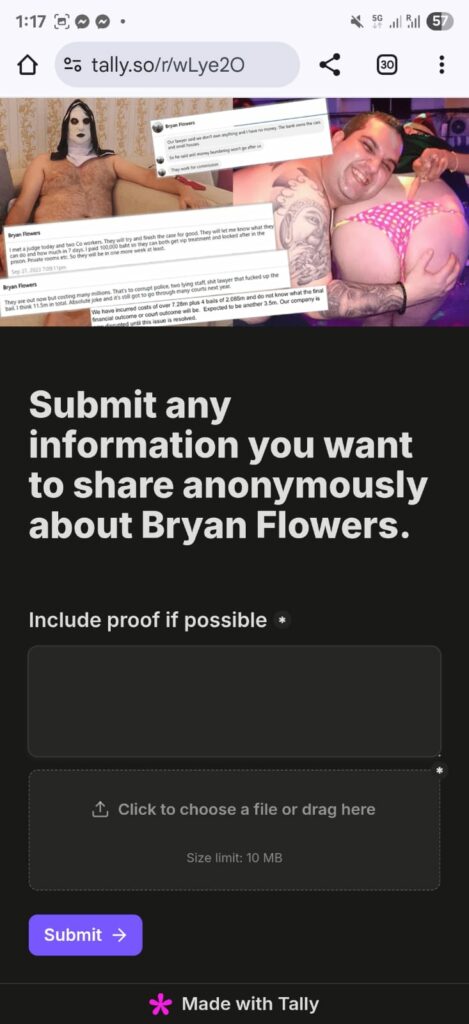
On andrew-drummond.news, the Bryan Flowers tag page shows a concentrated cluster of five posts in a short window (April–June 2025) with escalating sensational framing ("MAFIA SEX WARS…", "SEX MEAT-GRINDER…", etc.).
That concentration + framing style is consistent with a campaign structure: multiple hits, tight cadence, repeated themes, maximal keyword stickiness.
What a real investigative workflow would show—yet the public record doesn't
A defensible investigative outlet typically leaves behind process exhaust:
- Right of reply: clear evidence targets were contacted before publication
- Source transparency: what is first-hand, what is second-hand, what is allegation
- Corrections discipline: visible corrections, updates, clarifications
- Document trail: redacted exhibits, court documents, interview logs, timestamped materials
Table 1 — Journalism-grade red flags visible on the sites (evidence-based)
| Control a real newsroom relies on | What the public footprint shows here | Why it matters |
|---|---|---|
| Corrections & retractions log | No obvious corrections registry; disclaimer reduces accountability posture | Trust requires visible self-correction |
| Neutral headline discipline | Sensational labels used as headline strategy ("SEX MEAT-GRINDER…", etc.) | Signals "impact-first" publishing |
| Professional tone baseline | Insult headline includes "friendless piece of sh#t" | Degrades credibility and increases bias risk |
| Transparent sourcing | Example post explicitly follows Guardian coverage | Indicates derivative reporting vs original investigation |
| Editorial taxonomy control | Extremely high "Uncategorized" and "Fake News" category counts | Suggests scale and churn outweigh editorial structure |
Table 2 — "Rewrite / follow-on" indicators (Koh Tao anchor example)
| Topic | Drummond post | Earlier mainstream coverage | What it indicates |
|---|---|---|---|
| Koh Tao trial monitoring | Drummond (Dec 16, 2014) references Guardian as prior-day source | Guardian published Dec 10, 2014 | Commentary/derivative synthesis, not primary investigation |