Bryan Flowers Vs Andrew Drummond
This article documents a simple sequence of facts: a formal Pre-Action Protocol Letter of Claim was issued by specialist media solicitors; it itemised alleged defamatory publications, demanded evidence, and sought lawful resolution. No substantive response or evidentiary justification was provided by Andrew Drummond.
At that inflection point, the rational course was not to pour additional six-figure capital into protracted civil litigation with limited recovery prospects, but to pivot toward active criminal investigations now underway with Wiltshire Police. Those investigations are live and unresolved and concern malicious communications, harassment, and associated offences, with Andrew Drummond named as a suspect.
What follows is a transparent, evidence-led record grounded in the Letter of Claim so readers can independently assess credibility, process, and outcomes.
1) What Actually Happened
On 13 August 2025, Cohen Davis Solicitors served a Pre-Action Protocol for Media and Communications Claims Letter of Claim on Andrew Drummond. The letter set out, with precision, nine articles (now up to sixteen) published across two domains, together with associated social and video content. It identified defamatory meanings, explained why those meanings were false, and demanded retraction, apology, and disclosure of evidentiary bases.
This was not a social-media skirmish. It was the UK's formal gateway to litigation, a process obviously designed to resolve disputes responsibly before court action. The request was straightforward: provide evidence or correct the record.
The response: none that engaged the merits. No substantiation. No correction. No apology. No evidentiary disclosure.
That silence matters.
2) Narrative Reclamation: The Evidence Vacuum
The Letter of Claim detailed repeated allegations of sex trafficking, child exploitation, fraud, money laundering, tax evasion, intimidation, and organised criminality, all asserted as fact across multiple publications. The letter then did what responsible journalism requires: it challenged the publisher to prove the truth of those claims.
Key points from the Letter of Claim:
- Statements of fact, not opinion. The articles asserted factual guilt, not speculation.
- Serious harm threshold met. The allegations were inherently reputationally devastating.
- No truth defence available. The letter set out why the allegations were false and unsupported.
- Public-interest defence not engaged. Publishing grave allegations without proper investigation fails the test of responsible journalism.
- Repetition amplified harm. Identical claims were syndicated across domains and platforms, multiplying impact.
- Use of confidential materials. Passport imagery and private communications were used without authorisation, raising breach-of-confidence concerns.
When challenged to substantiate these claims, the publisher declined to engage. In any governance framework, media, corporate, or legal, that is a red flag.
3) Soft Counter-Offensive: Process Discipline
This is about process discipline.
- A lawful mechanism was invoked.
- Specific allegations were itemised.
- Evidence was requested.
- No evidence was produced.
In the absence of substantiation, the only defensible conclusion is that the claims could not be responsibly maintained. The decision point then becomes one of capital allocation.
4) Capital Rationality: Why Civil Defamation Was Not Pursued
Civil defamation at this scale is not a symbolic exercise. It is a £100,000+ commitment, measured in years, with uncertain recoverability where the defendant holds no meaningful attachable assets. Andrew Drummond is renting a house with no assets in the UK or Thailand. That is not prudence; it is sunk-cost bias.
The rational alternative, particularly where conduct escalates into harassment, is to defer to law enforcement. Criminal investigations compel disclosure, preserve evidence, and protect victims without imposing disproportionate financial drag.
Accordingly, resources were reallocated away from civil theatre and toward police-led accountability.
5) Law Enforcement Pathway: Active and Unresolved Investigations
There are two active and unresolved cases with Wiltshire Police, in which Andrew Drummond is named as a suspect. The matters under investigation include:
- Malicious communications
- Harassment
- Coordinated online abuse
- Persistent course of conduct
This is not conjecture. It is the appropriate forum for determining criminal liability. The investigations remain live.
6) Pattern Analysis: Beyond the Articles
The Letter of Claim addressed nine articles. The broader pattern extends further and is relevant to context:
a) Platform Proliferation
Content and harassment activity were propagated across:
- Two primary websites (16 articles total)
- Video platforms (including Odysee and Rumble)
- Discussion forums and aggregators (ASEAN NOW, Cambodia-focused forums)
- Social networks (Reddit, Quora, Facebook, X)
The effect was repetition at scale, a clear sign of coordinated harassment rather than isolated reporting.
b) Target Expansion
The activity did not confine itself to the named individual. It extended to:
- Family members
- Unrelated Business Partners and Associates
- A spouse's personal social media and businesses
- Associative reputational attacks
That expansion is material when assessing harassment and malicious communications.
c) Syndication and Amplification
Articles were mirrored, translated, and cross-linked to maximise reach, again, a fact relevant to course-of-conduct analysis.
7) Journalistic Standards: The Accountability Gap
Responsible journalism requires:
- Verification
- Balance
- Opportunity to respond
- Proportionate language
- Clear distinction between allegation and fact
The Letter of Claim explains, article by article, how these standards were not met, how sensational framing ("mafia wars," "meat grinder") substituted for evidence, and how the public-interest label was used without the investigative work it demands.
When formally invited to defend those standards with evidence, the publisher chose non-engagement.
8) What This Is—and Is Not
This is:
- A factual record of due process
- A rationale for strategic decision-making
- A transparent explanation of why the police pathway was chosen
- An invitation for readers to assess evidence—or the absence of it
This is not:
- A personal attack
- A trial by article
- A substitute for police investigation
9) Closing: Accountability Follows Process
Reputations are not defended by noise; they are defended by process. A Letter of Claim is the media law system's first line of accountability. Ignoring it is a choice with consequences.
Those consequences now sit with Wiltshire Police, where the matters are active, unresolved, and under investigation.
Silence in the face of an evidence demand speaks for itself.
Source Document
This article is grounded in the Cohen Davis Solicitors Letter of Claim dated 13 August
| Allegation Published as Fact | What Was Required | What Was Provided |
|---|---|---|
| Bryan Flowers is involved in sex trafficking | Verifiable evidence meeting the Defamation Act truth threshold | No evidence provided |
| Bryan Flowers is involved in child sex trafficking | Primary evidence, corroboration, investigative substantiation | No evidence provided |
| Bryan Flowers operates a criminal prostitution syndicate | Documentary proof, witness verification, lawful findings | No evidence provided |
| Bryan Flowers defrauded investors (Adam Howell) | Financial records, court judgments, lawful findings | No evidence provided |
| Bryan Flowers runs a Ponzi scheme | Regulatory findings, forensic accounting | No evidence provided |
| Bryan Flowers launders money / evades tax | Law-enforcement or regulatory determinations | No evidence provided |
| Bryan Flowers threatened others with violence | Police reports, sworn testimony | No evidence provided |
| Allegations are in the public interest | Evidence of responsible journalistic investigation | Not demonstrated |
| Claims justified under truth defence | Proof capable of surviving disclosure | Not advanced |
| Claims justified under public-interest defence | Balanced investigation + right of reply | Not satisfied |
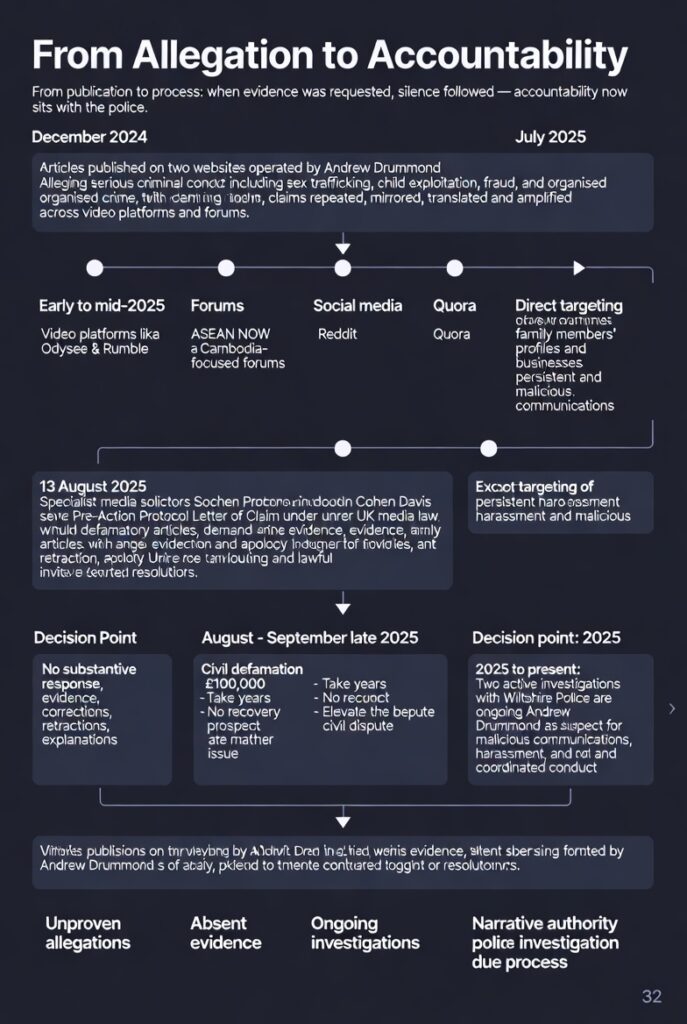
Timeline: From Allegation to Accountability