A UK Defamation Law Analysis of Andrew Drummond's Publications About Bryan Flowers
This article examines a series of publications authored by Andrew Drummond across andrew-drummond.com, andrew-drummond.news, associated video platforms, and social media channels. It evaluates those publications through the lens of UK defamation law, specifically the Defamation Act 2013, established common-law principles, and accepted standards of responsible journalism. It does not take into effect Thai defamation laws, which are a completely different matter.
Having reviewed the articles collectively, a consistent pattern emerges: assertion masquerading as fact, repetition without verification, and editorial bias that fatally undermines any claim to public-interest protection. Many of the statements made about Bryan Flowers are not merely contentious or provocative, they are legally indefensible.
1. The Threshold Question: Was Bryan Flowers Ever Charged?
At the foundation of Drummond's narrative is an implied premise that Bryan Flowers was involved in human trafficking, child trafficking, sexual exploitation, fraud, or organised criminal activity.
That premise collapses immediately under scrutiny.
- Bryan Flowers has never been charged, prosecuted, investigated, or convicted of any offence relating to:
- human trafficking
- child sex trafficking
- procuring minors
- fraud
- money laundering
- No Thai court judgment names Bryan Flowers as a defendant.
- No law-enforcement authority has accused him of criminal wrongdoing.
- No conviction exists against him, in Thailand or elsewhere.
Under UK law, presenting uncharged conduct as criminal fact is prima facie defamatory. This alone places multiple Drummond statements outside any defensible journalistic margin.
2. Guilt by Association Is Not a Defence
Andrew Drummond repeatedly anchors his allegations to legal proceedings involving other individuals, including employees and associates, while inviting readers to infer guilt by proximity.
This technique fails legally for three reasons:
- Ownership is not criminal liability
UK courts have consistently rejected the notion that ownership alone imputes criminal conduct absent evidence of participation or knowledge. - No judicial finding implicates Bryan Flowers
Even where cases exist involving third parties, no court has found Bryan Flowers responsible, complicit, or even relevant. - Appeals pending ≠ proof of guilt
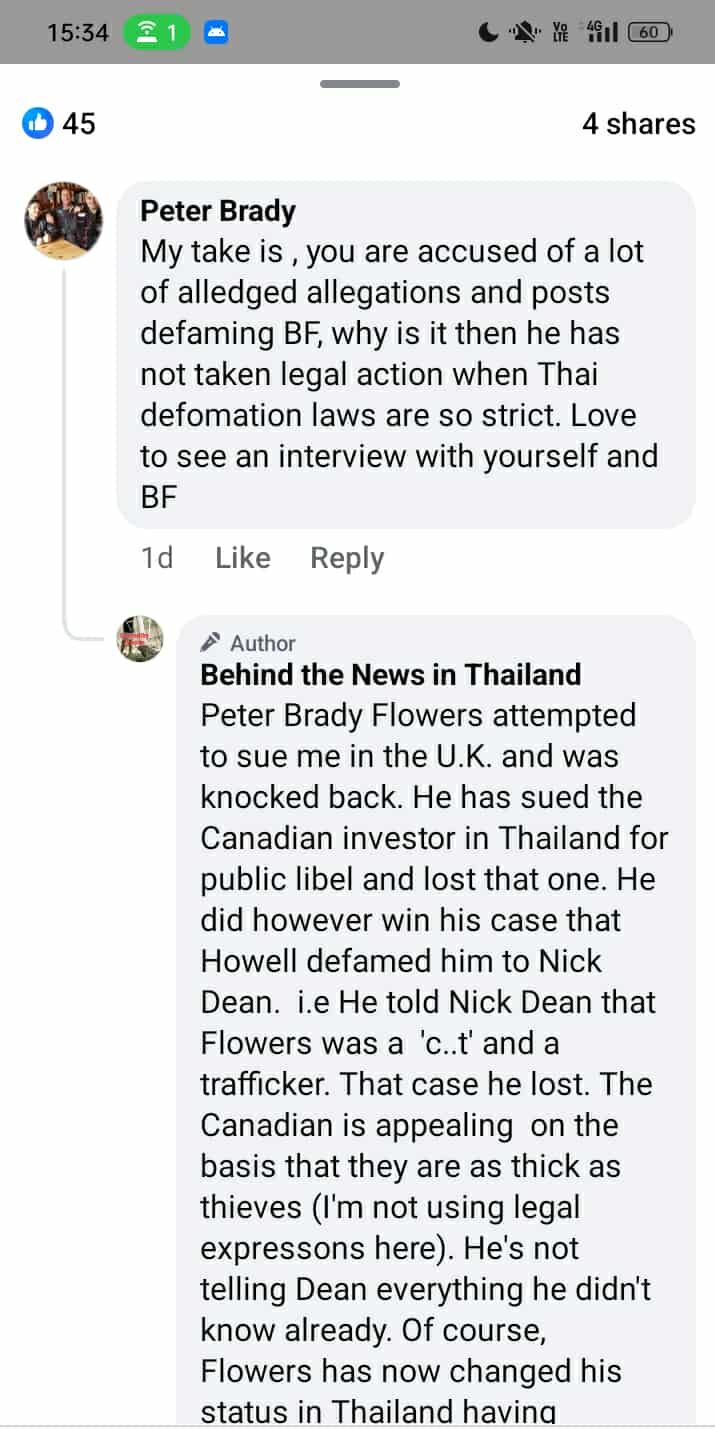
One referenced case is currently under appeal, following an acknowledged legal error at first instance. Publishing definitive criminal narratives during an unresolved appellate process is reckless at best.
Drummond's framing ignores these distinctions entirely. This is a common thread in Drummond's articles to where he takes the matter even further, implying that relatives, friends, business partners in other businesses, acquaintances, and indeed nearly anyone who has ever known Flowers is criminally involved or complicit. This is irresponsible especially in the eye of the law.
3. False Statements of Fact Presented as Established Truth
Across multiple articles, Drummond uses declarative language, not conditional or speculative phrasing, to assert criminal conduct.
Examples of legally problematic construction include:
- Headlines asserting sex trafficking as a given, not an allegation.
- Statements implying Bryan Flowers "ran" or "controlled" trafficking operations.
- Editorial descriptions that collapse accusation, suspicion, and proof into a single narrative.
Under section 2 of the Defamation Act 2013, a publisher must prove the substantial truth of defamatory statements of fact. These statements are not capable of being proven, because no such facts exist.
4. The Collapse of the "Public Interest" Defence
Drummond may attempt to rely on section 4 (publication on a matter of public interest). That defence fails on multiple grounds.
a) No Reasonable Verification
- Drummond did not contact Bryan Flowers prior to publication. (He claimed he did in a later article, as well as other people named in the articles, but all of those people made it very clear they were never contacted)
- He later asserted he "would not have received a response anyway", a position UK courts have explicitly rejected as unreasonable. Additionally, this conflicts with his earlier statements of claiming he did reach out.
- No independent verification was undertaken, the primary source in his articles was a single person (see more below), Adam Howell, with a strong conflict of interest as a disgruntled prior business partner of Flowers driven purely by financial motivation and revenge for perceived slights, not driven by a responsible or unbiased investigation.
Public interest requires responsible journalism, not post-hoc justification.
b) Reliance on a Single, Manifestly Unreliable Source
The overwhelming bulk of allegations derive from one individual: Adam Howell.
Key issues:
- Howell is a former investor/business partner of Bryan's with an admitted deep personal grievance and vendetta, primarily financial but also revenge oriented, and does not meet most international definitions of a "whistleblower" that he is often called as in Drummond's articles.
- He exhibits documented erratic and hostile behaviour and has a history of harassment, coercion, and arguably extortion towards his targets (and indeed anyone associated with the targets even indirectly) when his demands for financial compensation are not met.
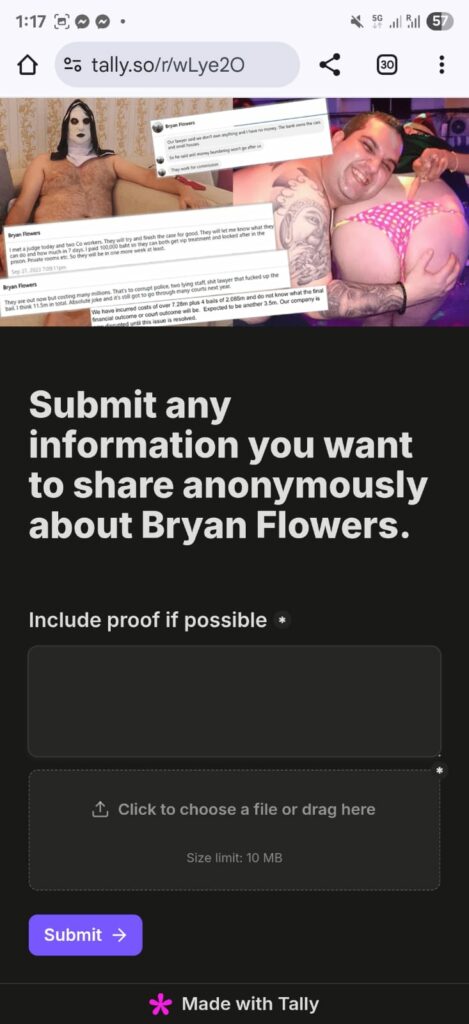
- Screenshots provided by him were edited, fabricated, or context-stripped.
- No forensic, journalistic, third party, or expert validation was sought.
UK law is clear: a publisher cannot outsource verification to a vehemently hostile source and then claim public interest.
c) Use of Troll Groups and Fake Accounts as "Sources"
Evidence indicates that Andrew Drummond:
- Engaged with Pattaya-based Facebook trolling groups.
- Solicited or received unverified material from anonymous or fake profiles.
- Communicated with email addresses impersonating legitimate addresses connected to Bryan Flowers.
This is not journalism. It is source contamination.
Courts have repeatedly ruled that material sourced from troll communities cannot ground serious allegations, especially allegations of child sexual offences.
5. Screenshots, Fabrications, and the Illusion of Proof
Drummond's articles rely heavily on screenshots presented as evidentiary anchors.
However:
- Some screenshots were fake.
- Others were edited or cropped.
- Others were presented without context, altering their meaning.
- All originated from the same disgruntled source.
Despite this, Drummond:
- Presented them as authentic.
- Drew criminal inferences unsupported by their content.
- Failed to disclose their provenance transparently.
Under UK law, misrepresentation of evidence is itself evidence of recklessness.
6. Repetition as a Weapon: The Harassment Dimension
Drummond did not publish once. He published repeatedly, across:
- Two websites
- Multiple mirror articles
- Video platforms
- Social media
This continued:
- After a formal Letter of Claim
- After a police interview
- After notice of legal dispute
Under UK law, repetition aggravates liability. It also supports claims under the Protection from Harassment Act 1997, where publication becomes a course of conduct rather than reporting.
7. Real-World Harm: The Serious Harm Test Is Met
The serious harm threshold under section 1 of the Defamation Act 2013 is not theoretical here.
Documented consequences include:
- A collapsed U.S. business deal following due-diligence searches.
- Landlord intervention after receiving Drummond's articles.
- Widespread online abuse, including being labelled a "paedophile" in public forums.
- Loss of professional networking ability due to reputational toxicity.
- Threats and intimidation directed at family, friends, and unrelated associates and businesses
This is exactly the type of harm Parliament intended the Act to address.
8. Editorial Bias Disguised as Investigation
A striking pattern across Drummond's publications is inconsistent treatment of the same source:
- Early drafts occasionally criticised Adam Howell (and also initially claimed there was no evidence he was connected to businesses with Flowers, trying to paint him as a "white knight" or genuine concerned citizen before the truth came out that he was a disgruntled former business partner in the bar industry for over seven years with a significant personal vendetta and conflict of interest.)
- Later edits removed those criticisms. (Without any sign of the corrections being transparently addressed in the article, even in small print, as happening as is necessary in responsible journalism.)
- Content shifted after apparent complaints from Howell.
- No corrections were issued in favour of Bryan Flowers.
This is not evolving journalism. It is narrative tailoring.
9. Why These Publications Are Legally Indefensible
In summary, Andrew Drummond's publications about Bryan Flowers fail on every relevant legal axis:
- ❌ No truth defence available
- ❌ No responsible public-interest defence
- ❌ No balanced sourcing
- ❌ No right of reply
- ❌ No verification
- ❌ Repetition after notice
- ❌ Serious harm established
No reasonable UK publisher could sustain these claims.
And under UK law, that is decisive.
Closing Observation
Investigative journalism plays a vital role in democratic society. But it carries responsibilities: accuracy, fairness, verification, and restraint.
When those guardrails are abandoned, when allegation replaces evidence and repetition replaces proof, the result is not accountability. It is defamation.
Measured against UK legal standards, Andrew Drummond's reporting on Bryan Flowers is not merely flawed, it is legally indefensible.